Page 1
UNIVERSE #####, ###################
##:##, ##/##/####
«There was no time to think even a single syllable.»
0:00 / 1:16
Nino Dello Buono and the MULTIVERSE saga's debut
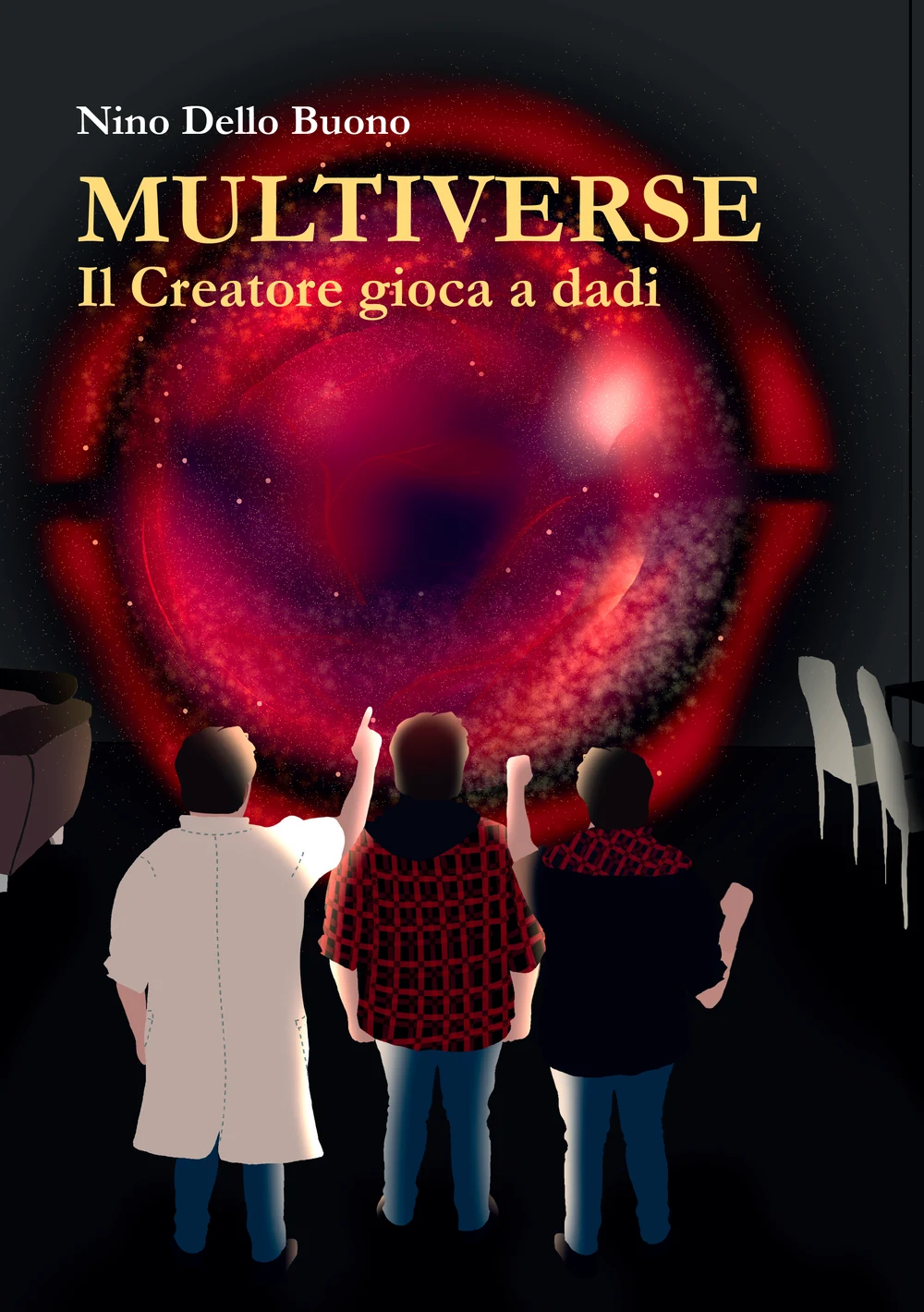
Il Creatore gioca a dadi
(The Creator plays dice)
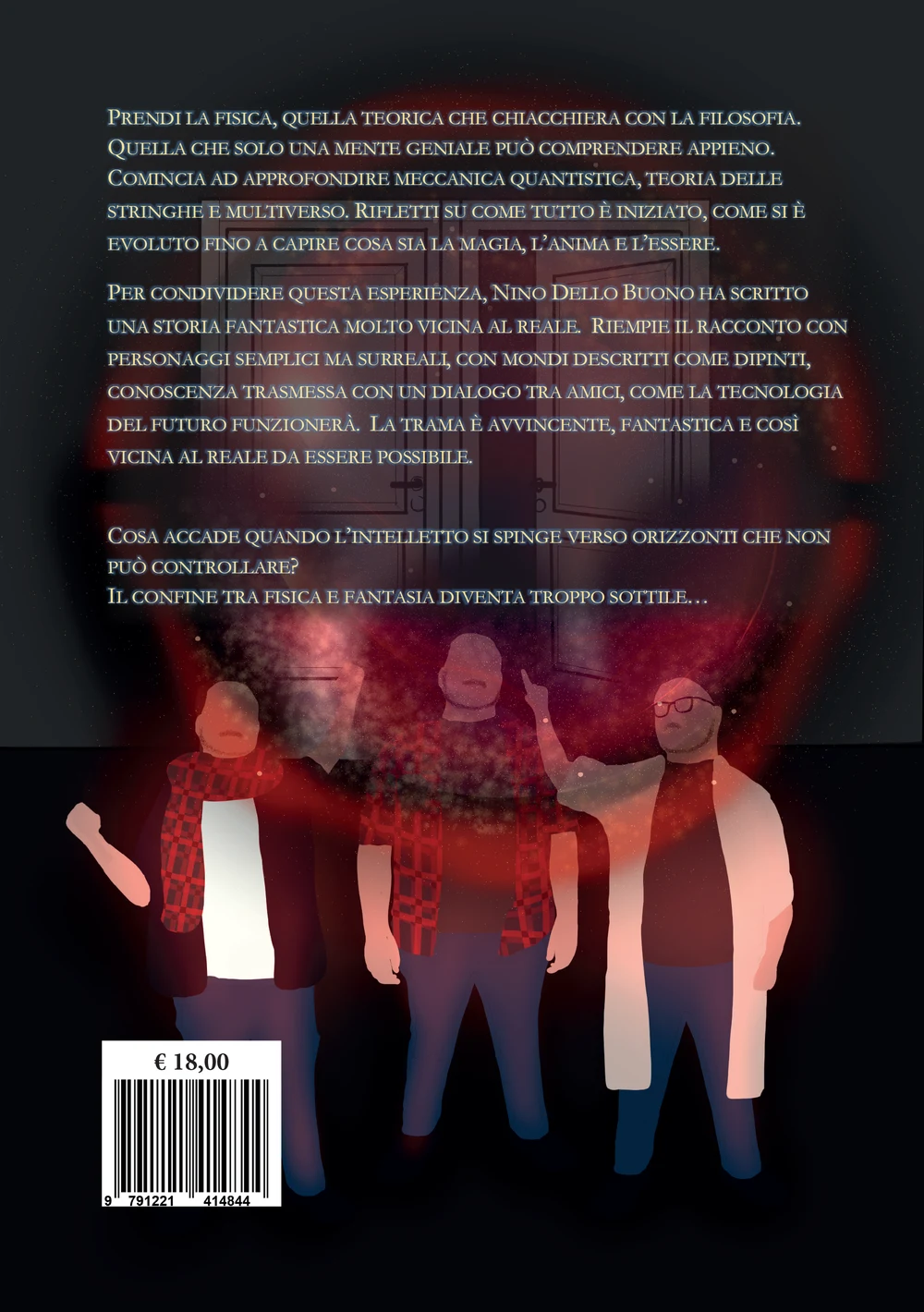
A group of young women and men, the creator of the multiverse and a catastrophe of interdimensional proportions. Only one week to save everything.
It's the first volume of the MULTIVERSE saga. It comes out in 2022 and, after a question from the audience, it was rewritten front to back for the 2024 second edition, the one you'll currently find in stores.
StreetLib, July 10, 2024
333 pages
ISBN 9791222498997
Cover by Anna Lo Feudo
Editing by Danila Lunardini
First edition Youcanprint, June 29, 2022

The plot
Red is just an ordinary guy. One morning, he finds a double of himself at his door, Science, who catapults him into the multiverse. Between a quantum mechanics formula and a chat about magic, Camera, the creator of the multiverse, joins them too.
A few years go by and the three make new friends until Science, a brilliant scientist, discovers an unprecedented potential catastrophe. The three will have to defeat a threat that lurks between one universe and the other and is slowly changing the constants of physics.
Each of them, alike in biology but different in psychology, reacts in their own way. The only way to decide what to do is to use philosophy and logic to convince the Company, the group that has come together around them between their travels.
There was no time to think even a single syllable.
In a corridor that stretched claustrophobically as far as the eye could see, there were columns finished down to the smallest detail and, as the narrow room went on, the style of the columns evolved and retraced the history of mankind.
At the entrance, megalithic pillars reminiscent of Stonehenge. Then Doric columns, then Ionic, and after that Corinthian. The march of history, reproduced in that place, did not stop at the Romans. Further and further along, all of them made of a strange ochre-colored marble, the columns followed one another in Gothic style, then Renaissance, 16th-century, Baroque. At the end of the great hall, darkened by the dim light, an austere but imposing pillar held up that depiction of the relentless passage of time, in cahoots with the megaliths at the entrance.
The floor, made of that same peculiar ochre marble, was puzzling because of a quirk of its own. Naturally within the block of stone itself, some large orange squares shifted color just enough to make those differently colored patches look like tiles. The floor was perfectly smooth to the touch, but sight screamed that it was not all in one piece.
The windows, symmetrical on either side of each column, acted like silent guardians letting in the light of the night that went on calmly outside, a clear night whose stars had been silenced by the deafening glare of the full moon. The shadows of the wrought-iron inlays were cast on the ground, distorted by perspective. Although the light could barely be perceived, the shapes of those inlays could have blinded anyone who studied them too closely from certain spots.
In that corridor, so rich in details and finishes, a young man was fleeing in terror. His short beard and brown hair, soaked with the sweat streaming down his forehead and temples, were pushed against the wind by the rest of his face, caught in an expression of sheer panic. His black T-shirt, loose enough to crease but not enough to get in the way of his movements, was being put to the test by the marathon just like the red and black plaid shirt he wore over it. His jeans and sneakers, worn out by that race against time, were barely holding
How it begins
The first chapter is different from all the others because, unlike the rest of «Il Creatore gioca a dadi», the author sort of lived it. It is in fact the transcription of a recurring nightmare he had between January and July 2018. A hall with columns in ever-changing styles, retracing the history of humanity from megaliths to the present, and someone running between them for dear life.
Dello Buono told us the dream wasn't the same every night, sometimes there was a bit of room to react. The version that came back most often, though, is the one in chapter 1. Are the universe, place, time and date redacted or are they beyond these four dimensions?
Listen to the page read by the author in his native tongue.
Page 1
UNIVERSE #####, ###################
##:##, ##/##/####
«There was no time to think even a single syllable.»
How to solve it
Every universe in the Company gets just one vote and, this time, a decision needs unanimity. There are three paths on the table and every universe weighs them against its own history and its own idea of what's right. The arguments run on logic and philosophy, not force. Before convincing the others, each universe's group has to make a decision, which doesn't always happen.
The book doesn't say who's right. Everyone is right in their own way and that's exactly the problem.
Camera can fix the constants of physics and bring the multiverse back to the values it always had. To do it, though, he needs a whole day to charge up. The countdown has already started.
On top of the previous option's reset, identical timelines reunite. Fewer copies of the same story, a more stable multiverse, the risk of something similar happening again decreases.
If all else fails, the Hail Mary solution involves saving a copy of humanity in a universe, shot faster than light away from the rest of the multiverse. Albert, with his superior mind, will have to choose who gets to be saved.
Two editions
At the first presentation, on September 17, 2022, at the San Domenico Maggiore complex in Naples during the MAVV festival, a question comes from the audience. «Mr. Dello Buono, why are there no female characters?». Dello Buono answers with honesty, saying «I may have forgor». Following this event, starting in February 2023, the rewriting that brought two female characters already planned for the rest of the saga into each universe, Anna and Giada, officially began. New characters aside, the book is rewritten from top to bottom. More «show, don't tell», richer worlds and a few deliberate paradoxes. In U21, for example, spaceship antimatter is paid for in sesterces, because U21 descends from U9 where Rome and its coinage never fell. In U54, social stereotypes are flipped. And then there's Albert, a synthetic being who goes from an end-of-the-book cameo to a fully fledged character.
The cover art is still by Anna Lo Feudo as it was in the first version, while the editing is done by Danila Lunardini.
Fun fact: the second edition comes out on July 10, 2024, the very same day the novel's multiverse has only a few hours left.
Coincidences
Three ideas from «Il Creatore gioca a dadi» had some real applications in the real world. Next to each one, you'll find the novel's lines, word for word, and the date of the news. We'll leave the comparison to you.
Wireless charging
Roads in U3945 are made of solar panels and cars, strictly electric, charge as they drive. Page 179 says so, page 181 in the first edition. In 2023, Purdue University in West Lafayette, Indiana, USA, lab-tests stretches of road fitted with coils for recharging electric vehicles. In 2025, for the first time, a stretch of highway charges an electric truck traveling at over 100 kph.
«The engine didn't make a single sound, the car being electric and charged by the track it ran on. The high mountain road, which like every other road in that timeline had a smooth surface made of countless solar panels, wound its way between the hollows of the area and the mountain ridges.»
Classical-quantum supercomputing
As they wait for the end of the world, the Sciences build small extra computers to support the hybrid quantum supercomputer they built at the start of the week, as page 165 says. The Company will join efforts with them after a few days to make Camera's garage into a proper computation machine. On page 115, Shock describes them as «desktop computers the size of a phone». The idea resembles a combination of three NVIDIA products that only arrived recently united into a single device. We're talking about the H200 from 2023, a module that plugs into servers, the DGX Spark from 2025, for desktop supercomputing, and NVQLink, also from 2025, which connects supercomputers to quantum processors.
«Right after lunch your father started building a series of small computers that I presume are compatible with the machine you built last night. They look like desktop computers the size of a phone.»
Earth Similarity Index
In U21, the closest exoplanet to the Solar System is called Artemis and it's an Earth-like planet, with taller and slimmer life forms thanks to the lower gravity and red plant life because Proxima's light is mostly red. All shown between pages 108 and 110. On May 21, 2026, a study led by astrophysicist María Rosa Zapatero Osorio finds, through the activity of Proxima Centauri, signs of a magnetic interaction with planets b and d, respectively called Apollo and Artemis in the novel. It's a hint that the two have a magnetic field, one of the conditions needed around a star like Proxima to hold onto an atmosphere like Earth's.
«Plants reflect the kind of light the sun gives off the most, so they don't get burned. […] Since Proxima's light is mostly red, the plants on Artemis are red.»
«Hearing the word “multiverse” used as material for Marvel superheroes or a theme of fantasy books, one naturally wonders what the book contains. A fantasy story between science and fiction or something more?»