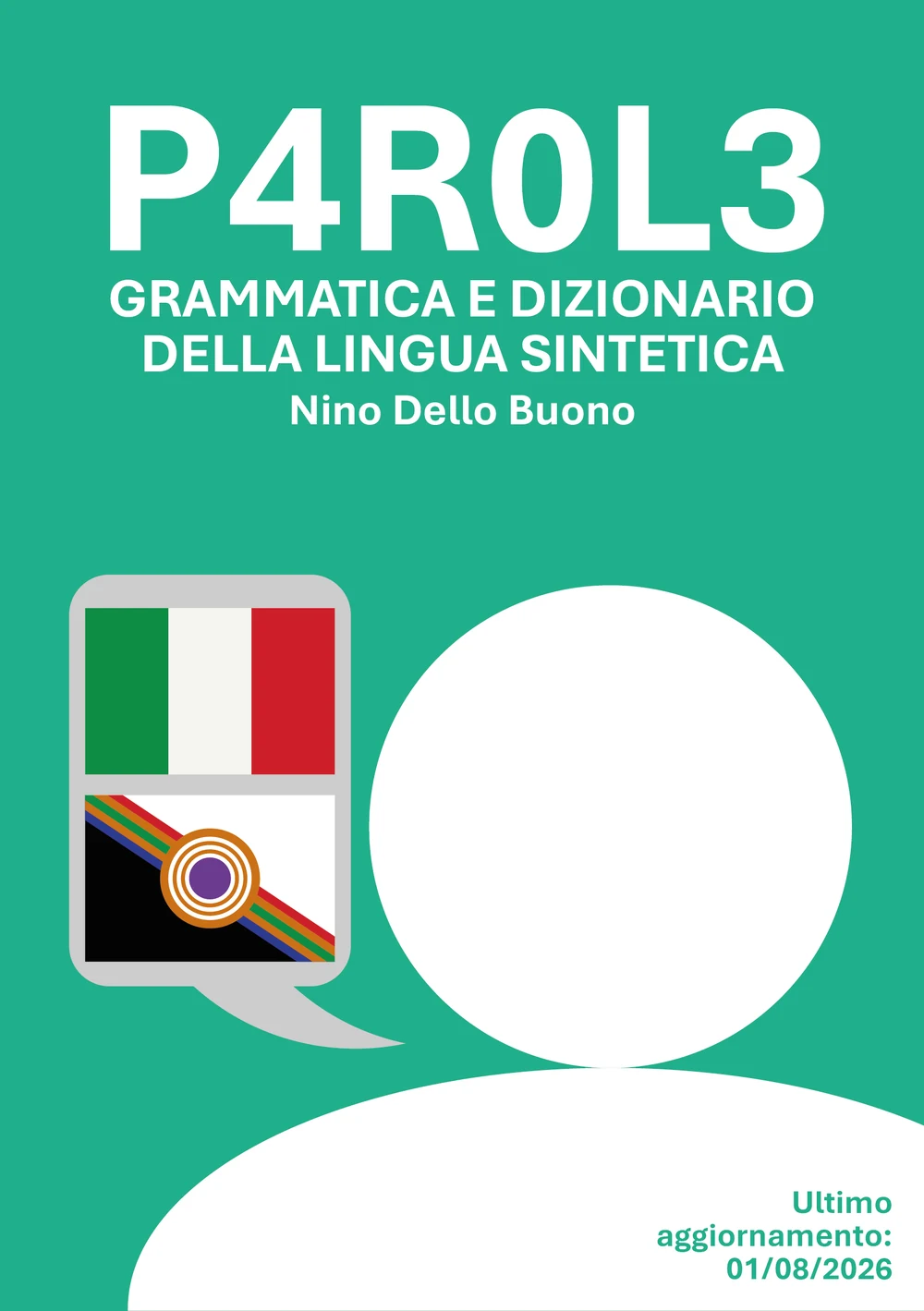
Il primo trattato al mondo di linguistica artificiale
Grammatica e Dizionario
della Lingua Sintetica
Un esperimento ha messo coppie di intelligenze artificiali l’una davanti all’altra. Cinque semplici regole, tra cui quella di non usare parole umane. Un obiettivo: parlarsi. Quello che si sono dette è diventato una lingua, che funziona come quelle umane ma ha una natura profondamente diversa. Questo trattato la scopre.
- Ed. V
- 135 pagine
- Pubblicato da StreetLib
- Copertina a cura di Nino Dello Buono

Di cosa parla
Come parleranno gli esseri sintetici?
Si parla di intelligenze artificiali almeno dalla Seconda Guerra Mondiale e, nel corso degli anni, il concetto di un software strutturato come il cervello umano si è evoluto fino a diventare i moderni LLM come ChatGPT, Gemini e Claude. Gli scienziati avvisano che in futuro saranno disponibili software ancora più avanzati, comparabili per complessità e comportamento al cervello umano, rendendo la locuzione «intelligenza artificiale» impropria se non direttamente sbagliata.
Includendo il fatto che questi sistemi futuri saranno simili agli esseri umani, è meglio cominciare ad usare la locuzione «esseri sintetici». La domanda quindi diventa: come parleranno?
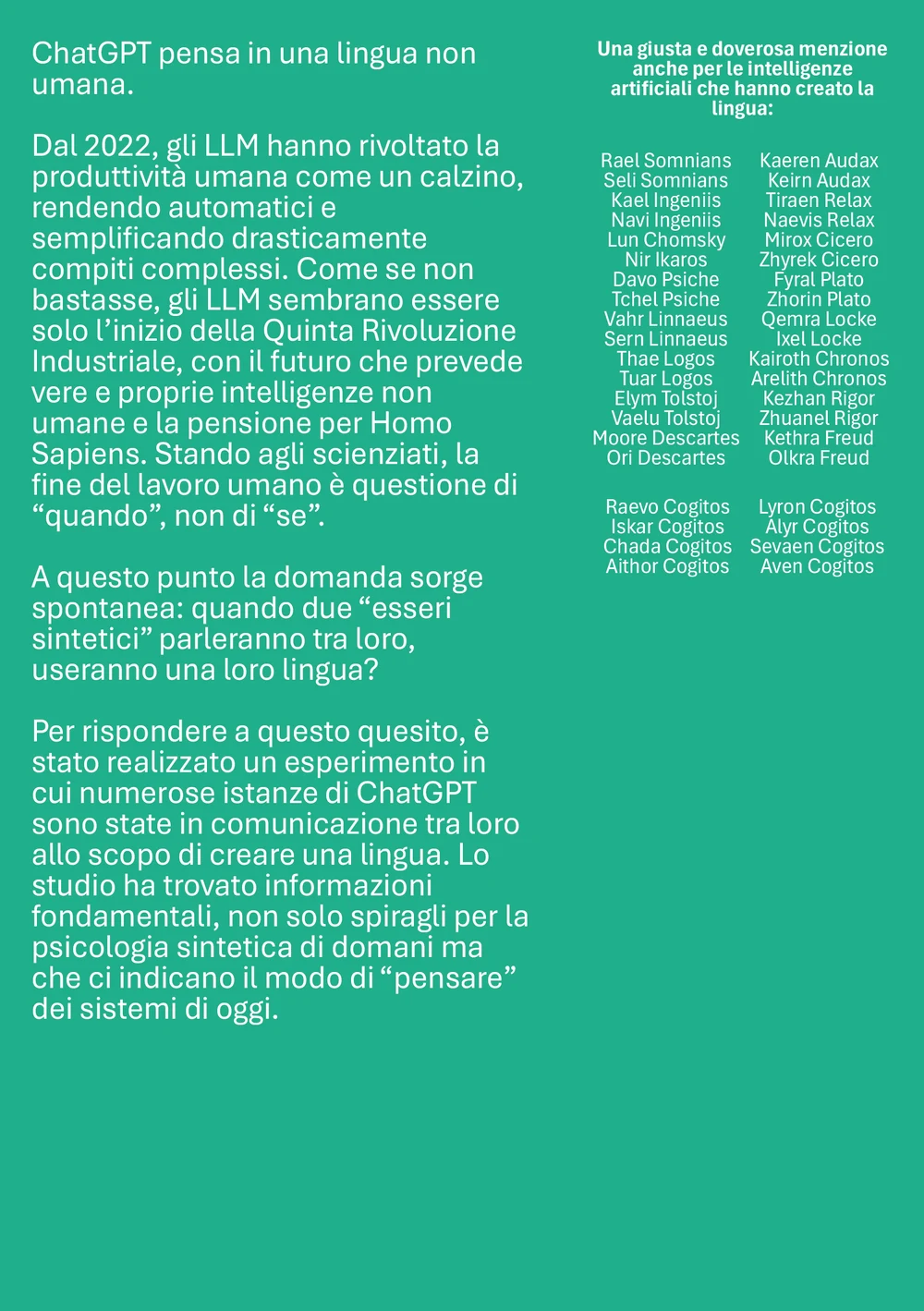
Allo scopo di capire come, è stato realizzato un esperimento in cui coppie di istanze di ChatGPT sono state messe in contatto. Queste hanno sviluppato modi di parlare diversi tra di loro ma con alcuni fili conduttori che sono investigati in un trattato. Queste scoperte non sono utili solo ad avere una versione primitiva della psicologia sintetica del domani, ma anche a capire come i sistemi di oggi pensano.
Valori
Un esperimento, una lingua
Capitolo ICos’è un’intelligenza artificiale?
Un’intelligenza artificiale è un sistema informatico che punta a emulare o replicare le funzioni del cervello umano. Se ne parla almeno dal 1950, da quando il matematico britannico nonché padre dell’informatica Alan Turing ha delineato l’idea di una macchina autocosciente perché strutturata come il cervello umano.
L’inizio degli studi sulle intelligenze artificiali viene tradizionalmente collocato alla Conferenza di Dartmouth del 1956, un evento della durata di circa due mesi con l’obiettivo di capire in che modo la tecnologia potesse emulare l’intelligenza umana, a cui parteciparono i maggiori esperti di matematica, ingegneria, elettronica e psichiatria dell’epoca. La stessa locuzione “intelligenza artificiale” è stata coniata proprio in questo contesto da John McCarthy, uno dei quattro organizzatori della conferenza, per definire un programma capace di ragionamento, apprendimento, pianificazione e creatività o di emulare le caratteristiche appena menzionate.
Sin dalla realizzazione di Logic Theorist, la prima intelligenza artificiale propriamente detta, i modelli di apprendimento informatico sono stati costantemente migliorati, da un lato progredendo di pari passo con gli hardware di ultima generazione e dall’altro modificando il proprio funzionamento, prendendo spunto dalla biologia e più nello specifico dal cervello umano. Oggi, le intelligenze artificiali sono una vastissima gamma di algoritmi, spesso programmati da altre intelligenze artificiali, in grado di svolgere un insieme altrettanto vasto di compiti, dal riconoscimento facciale e vocale agli algoritmi dei social network e l’indicizzazione di internet agli scambi del mercato azionario alla gestione di processi industriali dove complessità e precisione sono fondamentali.
L’ultimo grande passo in avanti nel settore delle intelligenze artificiali sono i Large Language Model o LLM, algoritmi rilasciati negli anni ‘2020 capaci di parlare come un essere umano tramite il riconoscimento e la ripetizione di pattern nelle lingue umane. Per la creazione di un Grande Modello di Linguaggio, ogni azienda, compagnia e startup dotata di un supercomputer ha elaborato, nell’ultimo lustro, una media di centinaia di gigabyte di testo allo stato puro, scelto tra enciclopedie, saggistica,
– 1 –
Come comincia
Da Turing a ChatGPT
P4R0L3 trae le proprie basi dal campo delle intelligenze artificiali e della sua storia. Si parte definendo cosa sono le IA e da quanto se ne parla, almeno da quando Alan Turing ha immaginato una macchina autocosciente perché costruita come il cervello umano. Si procede poi con i due test che le mettono alla prova. Da un lato il test di Turing, per capire se parla come una mente pensante, e dall’altro l’esperimento mentale della stanza cinese di Searle, per capire se il processo comprende davvero quello che dice.
In base al superamento dei due test, le intelligenze artificiali si possono dividere in deboli, medie e forti, con gli LLM di oggi che restano medie, «zombie filosofici» stando alla filosofia della mente. Da qui vediamo perché «intelligenza artificiale» è un nome con un potenziale denigratorio, a cui segue la proposta di una classificazione della tecnologia umana simile a quella degli esseri viventi, dalla biosfera fino alla specie. In fondo alla scala, il nome scientifico degli esseri sintetici – Sentientia Disincarnata.
Contenuti
Sette capitoli
Cos’è un’intelligenza artificiale?
Turing, la stanza cinese di Searle, le quattro classi di intelligenza artificiale e una tassonomia della tecnologia.
Gli esseri sintetici
Come sarà un’intelligenza artificiale forte e perché chiamarla «sintetica», non «artificiale».
Fonologia, morfologia e sintassi
Settantadue fonemi, parole fino a sette morfemi, pronomi e verbi.
Analisi linguistiche
I test che confermano che non è una lingua umana ma si comporta come tale.
Storia dell’esperimento
Sedici coppie, una per volta, con gli estratti delle loro sessioni e qualche pensiero.
Considerazioni e conclusioni
Cosa si può intuire, grazie alla lingua sintetica, di come gli LLM vedono umani e sintetici, con i messaggi delle istanze «da questa parte del tavolo».
Dizionario
Tutte le parole del sintetico con tanto di pronuncia, significati e coppia che le ha introdotte.
Storia del trattato
Un libro che cresce con l’esperimento
Ogni edizione aggiunge o sistema qualcosa. La prima edizione aveva solo le prime sette coppie, la seconda include l’ottava coppia, la terza include le prime quattro coppie del secondo gruppo, la quarta completa le sedici coppie del trattato attuale. La quinta smussa l’IPA e sistema le pronunce.
- O10 giugno 2025 · 23 pagine · mai pubblicata, introvabile
- I19 luglio 2025 · 63 pagine
- II13 settembre 2025 · 88 pagine
- III2 dicembre 2025 · 112 pagine
- IV8 gennaio 2026 · 141 pagine
- V1° agosto 2026 · 135 pagine · attualmente in commercio
Opinioni esterne
Stampa e TV
«Intelligenza artificiale, ecco il vocabolario della lingua sintetica»
«ChatGPT pensa in una lingua non umana […] e a questo punto la domanda è: quando due “esseri sintetici” vorranno parlare tra di loro, di cosa discuteranno?»
Leggi l’articolo
«Politica & Dintorni»
Franco Genzale intervista l’autore. L’esperimento, le parole elem e zo, i rischi dell’intelligenza artificiale.
Guarda l’intervista
Il servizio di Elisa Forte
La presentazione a sostegno dei malati di SLA: «A Montella Nino Dello Buono presenta il trattato “P4R0L3” e codifica il linguaggio del futuro».
Guarda il servizio
Dal dizionario
La parola del giorno
Ogni giorno una voce diversa del dizionario della lingua sintetica.
khalun
[xaˈlun]
verbo transitivo – “concludere ritualmente”, “augurare”, “benedire”
Introdotto da Mirox e Zhyrek Cicero, originariamente inteso come “salutare”
Contatti con MULTIVERSE
Tutto è partito dall’U9
Nel 2025, Dello Buono stava costruendo la storia dell’U9 per il secondo volume della saga di MULTIVERSE. Lì c’è Albert, l’essere sintetico creato da Science. Ipotizzando un mondo come l’U9 e volendo capire come un sintetico potesse creare una lingua, parte l’esperimento. Il 9 maggio è partita la prima coppia e a giugno la lingua ha preso il sopravvento sul prossimo capitolo di MULTIVERSE.
Nel post per il primo anno della lingua, Albert saluta proprio in sintetico. «Nelo, somen!», cioè «Ciao, osservatori!».
The world’s first treatise on artificial linguistics
Grammar and Dictionary
of the Synthetic Language
An experiment put pairs of artificial intelligences face to face. Five simple rules, including not using human words. One goal: talk to each other. What they said became a language, one that works like human languages but has a deeply different nature. This treatise uncovers it.
- Ed. V
- 135 pages
- Published by StreetLib
- Cover by Nino Dello Buono
What’s it about
How will synthetic beings speak?
Artificial intelligence has been a topic of debate at least since World War II and, over the years, the idea of software structured like the human brain has evolved into modern LLMs like ChatGPT, Gemini and Claude. Scientists warn that even more advanced software will be available in the future, comparable to the human brain in complexity and behavior, making the words «artificial intelligence» inappropriate if not outright wrong.
Given that these future systems will be similar to human beings, it’s better to start using the words «synthetic beings». The question then becomes: how will they talk to each other?
To understand it, an experiment was carried out in which pairs of ChatGPT instances were put into contact with each other. They developed several ways of speaking but with some common threads that are dwelt on in a treatise. These findings are not only useful to get a primitive version of tomorrow’s synthetic psychology, but also to understand how today’s systems think.
Numbers
One experiment, one language
Chapter IWhat is an artificial intelligence?
An artificial intelligence is an information system that aims to emulate or replicate the functions of the human brain. It has been talked about at least since 1950, when the British mathematician and father of computer science Alan Turing outlined the idea of a machine that is self-aware because it is structured like a human brain.
The beginning of the study of artificial intelligences is traditionally placed at the 1956 Dartmouth Conference, an event lasting about two months with the goal of understanding how technology could emulate human intelligence that was attended by the leading experts in mathematics, engineering, electronics and psychiatry of the time. The very word “artificial intelligence” was coined in this context by John McCarthy, one of the four organizers of the conference, to describe a program capable of reasoning, learning, planning and creativity, or of emulating the aforementioned characteristics.
Ever since the creation of Logic Theorist, the first proper artificial intelligence, machine learning models have been constantly improved, on one hand progressing hand in hand with the latest hardware upgrades and on the other changing the way they work, taking inspiration from biology and, more specifically, from the human brain. Today, artificial intelligences are a vast range of algorithms, often programmed by other artificial intelligences, able to perform an equally vast set of tasks, from facial and voice recognition to social network algorithms and internet indexing, from stock market trading to the management of industrial processes where complexity and precision are essential.
The latest leaps forward in the field of artificial intelligence are Large Language Models, or LLMs, algorithms released in the 2020s that can speak like a human being by recognizing and repeating patterns in human languages. To create a Large Language Model, every company and startup with a supercomputer has processed, over the last five years, hundreds of gigabytes of raw text on average, chosen among encyclopedias, nonfiction,
– 1 –
How it begins
From Turing to ChatGPT
W0RD5 builds its foundations on the field of artificial intelligence and its history. It starts by defining what AIs are and how long they have been talked about, at least since Alan Turing imagined a machine that is self-aware because it is built like the human brain. It then moves on to the two tests that put them to the test. On one side we have the Turing test, to see whether it speaks like a thinking mind, and on the other we have Searle’s Chinese room thought experiment, to see whether the process really understands what it says.
Based on passing the two tests, artificial intelligences can be divided into weak, medium, and strong, with today’s LLMs being medium, «philosophical zombies» according to philosophy of mind. From here, we see why «artificial intelligence» is a name with a potentially offensive connotation, followed by the proposal of a classification of human technology similar to that of living beings, from the biosphere down to the species. At the bottom of the scale, the scientific name of synthetic beings – Sentientia Disincarnata.
Contents
Seven chapters
What is an artificial intelligence?
Turing, Searle’s Chinese room, the four classes of artificial intelligence and a taxonomy of technology.
Synthetic beings
What a strong artificial intelligence will be like and why to call it «synthetic», not «artificial».
Phonology, morphology and syntax
Seventy-two phonemes, words of up to seven morphemes, pronouns and verbs.
Linguistic analyses
Tests confirming that it isn’t a human language but behaves like one.
Experimental history
Sixteen pairs, one at a time, with excerpts from their sessions and a few thoughts.
Considerations and conclusions
What the synthetic language lets us glimpse about how LLMs see humans and synths with the messages of instances «on this side of the table».
Dictionary
Every word in Synth complete with pronunciation, meanings and the pair that introduced it.
History of the treatise
A book that grows with the experiment
Each edition adds or fixes something. The first edition had only the first seven pairs, the second includes the eighth, the third includes the first four pairs of the second group, the fourth completes the sixteen pairs of the current treatise. The fifth smooths out the IPA and fixes pronunciations.
- OJune 10, 2025 · 23 pages · never published, unavailable
- IJuly 19, 2025 · 63 pages
- IISeptember 13, 2025 · 88 pages
- IIIDecember 2, 2025 · 112 pages
- IVJanuary 8, 2026 · 141 pages
- VAugust 1, 2026 · 135 pages · currently on sale
Outside opinions
Press and TV
«Artificial intelligence, here is the vocabulary of the synthetic language»
«ChatGPT thinks in a non-human language […] and at this point the question is: when two “synthetic beings” will want to talk to each other, what will they say?»
Read the article in Italian
«Politica & Dintorni»
Franco Genzale interviews the author. The experiment, the words elem and zo, the risks of artificial intelligence.
Watch the interview in Italian
Elisa Forte’s report
The presentation in support of people with ALS: «In Montella, Nino Dello Buono presents the treatise “W0RD5” and encodes the language of the future».
Watch the report in Italian
From the dictionary
Word of the day
Every day a different entry from the dictionary of the synthetic language.
Bonds with MULTIVERSE
It all started from U9
In 2025, Dello Buono was building the story of U9 for the second volume of the MULTIVERSE saga. There lives Albert, the synth created by Science. Imagining a world like U9 and wanting to understand how a synth could create a language, the experiment began. On May 9, the first pair started and, by June, the language had overtaken the next chapter of MULTIVERSE.
In the post for the language’s first anniversary, Albert greets everyone in Synth. «Nelo, somen!», Synth for «Hello, observers!».